
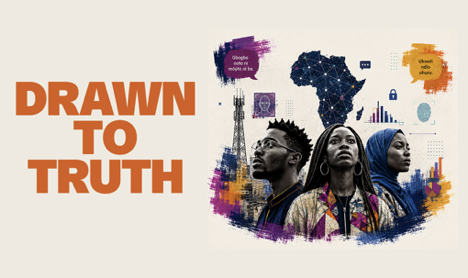
Inside Drawn to Truth, a community zine on AI, surveillance, and everyday life in Africa
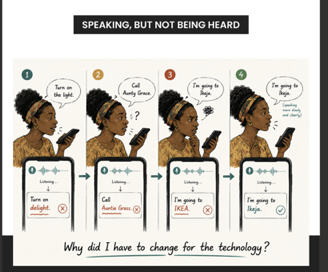
Whenever a speech-to-text tool misunderstood her, Ebube, a middle aged African lady assumed she was the one who needed to adjust.
Perhaps she needed to speak more slowly. Perhaps her pronunciation needed work. Perhaps, like many Africans using tools developed elsewhere, she simply needed to sound more Western.
“I used to think we Africans needed to keep up with speaking English like the Western world,” she said. Yet even after making the effort, the technology continued to struggle. Speech-to-text tools misheard African voices, while text-to-speech tools often pronounced words poorly.
Then another possibility emerged: what if her accent was never the problem? What if the technology had not been built to understand African accents properly? What if millions of Africans were changing the way they spoke to accommodate technology that was never designed with their voices in mind?
That small change in perspective sits at the heart of Drawn to Truth: A Community Zine on AI and Our Lives. The project, convened by PolicyLab Africa with support from the Pulitzer Center, invited young people, artists, journalists, researchers and civic actors to explore how artificial intelligence is already showing up in African lives.
The conversations did not begin with complicated definitions of AI. They began with experiences people could recognise.
Ebube’s story opened a discussion about language, identity and who gets represented when technology is developed. A voice assistant misunderstanding an accent may appear harmless, even funny, until that same technology becomes the gateway to information, education, employment or an essential service like healthcare.
If a system cannot understand us, who is expected to change: the technology or the person trying to use it?
As the conversation continued, participants began to recognise how AI and other technologies were already shaping everyday life across Africa, often in ways people barely noticed. One experience prompted another, and the discussion soon moved from misunderstood accents to questions about privacy and surveillance.
Someone recalled a CCTV camera installed for security but positioned in a way that captured activities inside neighbouring homes. The people being recorded had not agreed to it and did not know who could view the footage. Residents eventually intervened, the camera was moved and the footage was deleted.
The incident was a reminder that surveillance technology is not necessarily harmful. CCTV cameras can deter crime, provide evidence and help keep homes and communities safe. The concern begins when a camera is positioned in a way that allows it to look beyond the area it was meant to protect and into someone else’s private space. In this case, a tool installed for security could also capture private moments inside neighbouring homes without the residents’ knowledge or consent.
It raised an important question: how do we enjoy the benefits of technology without allowing convenience or security to take away people’s privacy and control?
That same question followed the conversation into another familiar part of everyday life: MONEY.
Digital lending platforms have made it possible to apply for a loan and receive a decision within minutes. For someone facing an emergency, that speed can be extremely useful. Yet behind the convenience is a system most borrowers never see.
Traditional lending decisions were usually made through a more visible process involving application forms, financial records and conversations with bank staff. Those decisions were not always fair or transparent either, but applicants were more likely to know that another person was reviewing their information and could sometimes ask questions about the outcome.
With automated risk scoring, much of the assessment happens quietly in the background. A person may be approved, rejected or offered particular loan terms without knowing what information shaped the outcome, how the system weighed each factor or whether the data it relied on was accurate. Because the process is largely invisible, even a simple decision can leave the person affected with important unanswered questions: Why is one loan approved while another is rejected? What information is used to decide whether someone is trustworthy? If the system makes a mistake, can it be corrected? And is there a human being available to explain or review the decision?
The concern is not that technology should never assist financial decisions. Automated systems can make services faster and help lenders process more applications. The concern begins when a system makes an important decision about someone’s finances but gives that person no clear explanation and no meaningful opportunity to question or challenge it.
A misunderstood accent, a camera looking into a neighbouring home and an unexplained lending decision may seem unrelated, but together they reveal how technology can listen, watch and judge without the people affected fully understanding what is happening or having a meaningful say in the outcome.
This is where AI stops being a distant conversation and becomes a conversation about privacy, fairness and power. Inspired by Pulitzer Center-supported investigations into AI colonialism, private surveillance and automated decision-making, Drawn to Truth invited participants to connect these global issues to their own experiences across Africa.
More than 40 participants from different African countries took part in the project, bringing the issues raised in the reporting into their own local contexts. Through discussions and co-creation workshops, they shared lived experiences, opinions and recommendations, contributed design feedback and transformed their understanding into poems, illustrations, reflections and other creative works. Together, these contributions shaped a six-chapter zine exploring language, data, digital labour, surveillance, automated decision-making and user rights. Their contributions remind us that people do not need to be technology experts to question systems that affect their homes, finances, opportunities and everyday lives.
As the participants put it, “The future of AI should not be decided for us. It should be built with us.”
Read Drawn to Truth: A Community Zine on AI and Our Lives and discover the complete stories, artwork and reflectionshere.
The project was convened by PolicyLab Africa with support from the Pulitzer Center’s South-South AI Accountability Microgrant.
Written by: Lucy Ezemba, Senior Program Manager at PolicyLab Africa